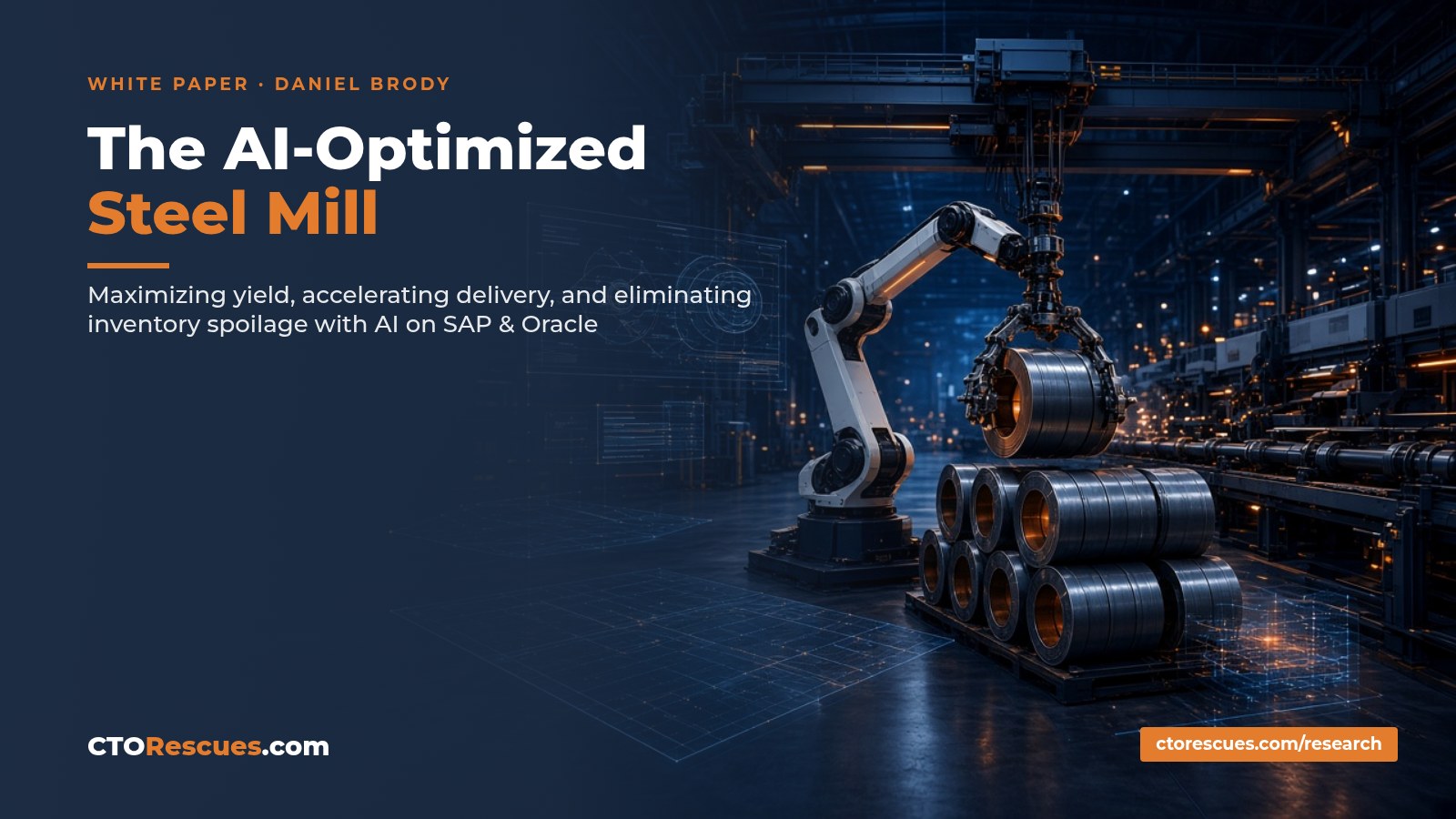
The AI-Optimized Steel Mill
Maximizing Yield, Accelerating Delivery, and Eliminating Inventory Spoilage through Enterprise Integration
By Daniel Brody, MBA and Expert in Metal Solutions | CTORescues.com · November 2026
Download the Full White Paper (PDF)
The complete AI optimization architecture for slitting and sheet cutting, SAP and Oracle integration, and the ROI model.
Download PDF - November 2026Why I Wrote This Paper
Before I spent my days on AI, ERP, and enterprise platforms, I spent eight years on the plant floor. From 2002 to 2010 I ran Steelman, a plant-floor manufacturing execution system (MES) built for steel processors and service centers, and helped grow it to $10M in recurring revenue. I have stood beside slitters at shift change, watched planners puzzle coils together on whiteboards and spreadsheets, and seen crane operators dig through bays for a coil that should have shipped months earlier.
The problems described in this paper are not abstractions to me. They are the same problems we fought with algorithms twenty years ago. What has changed is the toolset: AI and modern ERP integration platforms now make it possible to solve them globally, continuously, and natively inside SAP and Oracle. This paper is the blueprint I would hand any steel processing executive who asked me, "Where does AI actually pay for itself on my floor?"
Executive Summary
The modern steel processing and service center environment operates at the intersection of high volume, heavy capital investment, and historically razor-thin margins. Despite sweeping advancements in machinery, metallurgy, and robotics, the operational logic driving order fulfillment, inventory management, and machine setup remains fundamentally constrained by human limitations in multivariable optimization. When processing steel coils—specifically in slitting and sheet cutting lines—suboptimal planning directly translates to excessive scrap, extended downtime between head setups, and the insidious accumulation of aging, oxidizing inventory.
This white paper outlines a transformative Artificial Intelligence (AI) architecture designed as a seamless, high-performance "bolt-on" for enterprise resource planning (ERP) systems, specifically SAP and Oracle. By completely rethinking order consolidation, head setup optimization, and inventory depletion through an algorithmic lens, metal processing plants can double historical yield improvements, optimize floor space, and drastically reduce delivery lead times. As we navigate the complex industrial landscape of 2026, transitioning from reactive scheduling to proactive AI optimization is no longer a luxury; it is a fundamental requirement for competitive survival.
1. The Legacy Bottleneck in Metal Processing
In a traditional processing plant, production planners or operators sequence orders based on immediate delivery deadlines, immediate material availability, and localized logic. A planner looks at the queue for a specific slitter, checks what coils are on the floor, and attempts to puzzle together a run that satisfies the next 48 hours of demand. This localized, linear approach creates cascading inefficiencies across three critical vectors:
1.1. Suboptimal Head Setups and Yield Loss
Operators frequently set up slitter heads for narrow order groupings. If a customer requires three 12-inch slits and the master coil is 50 inches wide, the remaining 14 inches (minus edge trim) is essentially orphaned. This "drop" must either be scrapped or returned to stock. Furthermore, every head setup changeover requires machine downtime. During a changeover, operators must run test material through the newly configured knives to ensure tolerances are met, which directly wastes prime steel. The more changeovers a facility executes, the lower its overall yield and machine utilization.
1.2. The Hidden Costs of "Return to Stock"
When a master coil is partially consumed, the remainder is banded, tagged, and moved back into inventory. This "Return to Stock" cycle generates massive, unmeasured costs. It requires crane operator time, increases the risk of edge damage during material handling, and consumes valuable warehouse footprint. A coil that is returned to stock three times before being fully consumed has effectively tripled its handling overhead, severely diluting the profit margin of the final product.
1.3. Inventory Degradation: The Spoilage Factor
Steel is rarely treated with the urgency of a perishable good like produce or dairy, yet chemically and financially, it acts exactly like one. Over time, exposed steel coils oxidize and rust. Old inventory becomes unsellable as prime material and often requires costly secondary processing, such as pickling and oiling, or heavy discounting.
When human planners select newer coils simply because they are sitting at the front of a bay, or because their widths are mathematically convenient for a specific order, older coils languish. They become buried under newer stock, and this aging material "spoils."
2. The Core AI Optimization Architecture
To resolve these legacy inefficiencies, the proposed AI optimization engine operates at the critical intersection of order management, machine configuration, and inventory control. Sitting directly on top of the facility's ERP, the AI acts as a holistic master scheduler. It abandons a linear, order-by-order approach in favor of global combinatorial optimization.
Step 1: Global Order Consolidation by Material Specifications
The AI continuously reviews the entire pipeline of open orders within the ERP. Rather than looking at what is due tomorrow for a single customer, it ingests all required deliveries across the entire enterprise and clusters them first by fundamental metallurgical requirements: heat/chemistry and thickness. By grouping all compatible orders regardless of their individual customer origin or immediate due date, the engine creates a massive, fluid pool of dimensional demands that can be flexibly combined.
Step 2: Algorithmic Slitting and Head Setup Optimization
Once orders are clustered by heat and chemistry, the AI runs advanced combinatorial optimization algorithms (often leveraging mixed-integer linear programming and machine learning heuristics) to piece these orders together across the full width of the master steel coils.
- Maximizing Coil Width Usage: The AI calculates mathematically perfect combinations of customer slit widths. It can instantly see that matching a 12-inch order due Tuesday, a 24-inch order due Thursday, and a 14-inch order due next Monday perfectly consumes a 50-inch master coil with minimal edge trim.
- Minimizing Head Setup Frequency: By intelligently stacking orders that utilize identical or highly similar slitter knife configurations, the AI drastically reduces the number of changeovers required per shift. It sequences the runs so that operators only need to move a few spacers rather than rebuilding the entire arbor.
- Eliminating Waste and Restocking: The primary goal of dimensional matching is to consume the mother coil in its entirety in a single run. This virtually eliminates the labor-intensive practice of returning partial coils to stock, stops the creation of orphaned drops, and preserves prime material.
Step 3: Strict, Optimized FIFO Sourcing
With the optimal width combinations calculated, the AI turns to inventory selection. It searches the ERP's available stock from oldest to newest, strictly enforcing a First-In, First-Out (FIFO) methodology based on the required heat/chemistry, thickness, and optimal widths.
By actively prioritizing the oldest coils that fit the mathematical model, the AI systematically purges aging material from the facility. Treating steel with a strict "spoilage" mindset preserves material value. Clearing this old inventory optimizes warehouse space, drastically reduces the number of times a crane must move material to reach newer coils (digging), and speeds up the entire production lifecycle.
A Note on Governance: AI Recommends, People Decide
An optimization engine is only as valuable as the trust the floor places in it. In every deployment I would design, the AI proposes the schedule, the head setups, and the coil picks, and a named planner or production manager approves, adjusts, or overrides them. Every override becomes feedback the engine learns from. This is not about eliminating planners; it is about giving them a tool that can evaluate more combinations in seconds than a team could in a week, so their judgment is spent on exceptions, customers, and quality instead of puzzle-solving.
3. Extension to Sheet Cutting Operations
While slitting operations present the most obvious and mathematically intensive use case for this technology, identical logic applies directly to sheet cutting, cut-to-length, and blanking lines.
The AI reviews all rectangular blank orders, nests them algorithmically across the width and length of an incoming coil, and generates a dynamic cutting pattern that minimizes skeleton scrap. By pulling from the oldest inventory first and grouping orders by thickness and grade rather than just customer PO, sheet processors can realize the exact same benefits in material yield, reduced machine downtime, and increased inventory turns.
4. Enterprise Integration: Bolting Onto SAP and Oracle
The true power of this AI engine lies in its ability to operate natively within a facility's existing ERP environment. In 2026, standalone, siloed software is a liability. The AI optimization engine is designed as a direct "bolt-on" application for industry-standard platforms like SAP and Oracle, ensuring a single source of truth for all master data, inventory levels, and order statuses.
Integrating with SAP Environments
For metal processors running SAP, the AI engine leverages SAP Business Technology Platform (SAP BTP), which operates as SAP's cloud-native platform-as-a-service designed to build, connect, and intelligently automate business processes.
- Clean Core Strategy and OData: The integration adheres to SAP's "Clean Core" philosophy, meaning the AI engine sits outside the core ERP but communicates in real-time. This is achieved using standardized OData APIs to manage integration flows, ensuring seamless data extraction and write-backs without heavily modifying the core SAP S/4HANA environment.
- Execution-Ready Architecture: The AI ingests the unified data model directly from SAP. By mapping L4 and L5 process steps to SAP interfaces, the AI engine can pull real-time order backlogs, heat/chemistry data, and coil inventory locations, run its combinatorial optimization in the cloud, and push highly optimized production schedules directly back into the SAP PP (Production Planning) module.
Integrating with Oracle Environments
For organizations utilizing Oracle Cloud ERP, the AI engine seamlessly interfaces through Oracle Integration Cloud (OIC). OIC serves as a unified platform to connect applications, automate processes, and build a foundation for AI innovations.
- Secure Machine Learning Integration: Oracle's architecture relies on secure data connections and API-based communication between business applications and external machine learning models. The AI optimization engine utilizes these governed APIs to extract live inventory and order data.
- Workflow Orchestration: Once the AI calculates the optimal slitter configurations and FIFO inventory picks, OIC orchestrates the enterprise workflows to deliver these AI insights directly into the operational processes of the plant floor. This ensures that the Oracle manufacturing modules receive perfectly sequenced job orders without requiring manual data entry or secondary spreadsheets.
- Continuous Synchronization: Because Oracle Integration can coordinate hybrid orchestrated workflows, the moment a coil is consumed on the floor, the system synchronizes in real-time across the enterprise, allowing the AI to instantly re-optimize the remaining queue if an unexpected variable (like a machine fault) occurs.
5. Empirical Evidence and Projected ROI
The financial impact of algorithmic order processing in steel is not strictly theoretical. In a recent pilot program utilizing a preliminary, pre-AI version of this logic, the processing facility documented a sustained 2% improvement in overall material yield.
By upgrading from rigid heuristic algorithms to dynamic, machine-learning-driven AI—which can process exponentially more combinations, adapt to real-time order influxes via SAP or Oracle, and predict inventory degradation curves—plants are projected to double that yield improvement to 4%. In a high-volume steel mill processing millions of pounds of coil per month, a 4% yield recovery translates to millions of dollars directly added to the bottom line annually.
Beyond strict material yield, the holistic ROI encompasses several massive secondary financial drivers:
- Capacity Expansion (CapEx Avoidance): Reducing downtime between head setups directly increases machine utilization and throughput. This effectively creates "free" processing capacity on the floor, allowing the facility to take on more orders without the multimillion-dollar capital expenditure required to purchase and install new slitting lines.
- Working Capital Optimization: Improving inventory turns and strictly enforcing algorithmic FIFO eliminates rusted, spoiled coils. This directly frees up tied working capital, reduces scrap write-offs, and drastically lowers the carrying cost of inventory.
- Accelerated Delivery and Customer Satisfaction: A smoother, faster, and perfectly sequenced production flow drastically reduces lead times. By globally clustering orders, plants can fulfill customer requests faster, improving on-time delivery metrics and strengthening market positioning.
Conclusion
The integration of advanced AI optimization into SAP and Oracle ERPs represents a fundamental shift in steel and metal processing. By transitioning from reactive, localized human scheduling to proactive, globally optimal algorithmic planning, metal processing plants can systematically dismantle the legacy bottlenecks that have constrained industry profitability for decades.
Treating steel as a perishable asset and mathematically guaranteeing maximum width utilization transforms raw material waste and idle machine time into immediate, sustainable revenue. The technology is no longer theoretical—it is an enterprise-ready reality that redefines the limits of industrial yield.
Where to Start
For steel processors and service centers running SAP or Oracle, the first step is not a platform replacement. It is a short assessment of your open-order pipeline, slitter and cut-to-length setup history, and inventory aging, to size the yield, changeover, and spoilage opportunity on your own floor. If you would like to talk through what that looks like for your operation, reach me at dan@ctorescues.com.
Daniel Brody, MBA, is a fractional CTO and founder of CTORescues.com, and CTO of Axina Group. From 2002 to 2010 he ran the Steelman plant-floor MES for steel processors and service centers.
Download Full White Paper
The complete AI optimization architecture for slitting and sheet cutting, SAP and Oracle integration, and the ROI model.
Download PDF - November 2026Running a steel processing or service center operation on SAP or Oracle?
A fractional CTO engagement can size the yield, changeover, and inventory-spoilage opportunity on your floor and map the AI bolt-on to your ERP. Email dan@ctorescues.com.
Discuss Fractional CTO Support


