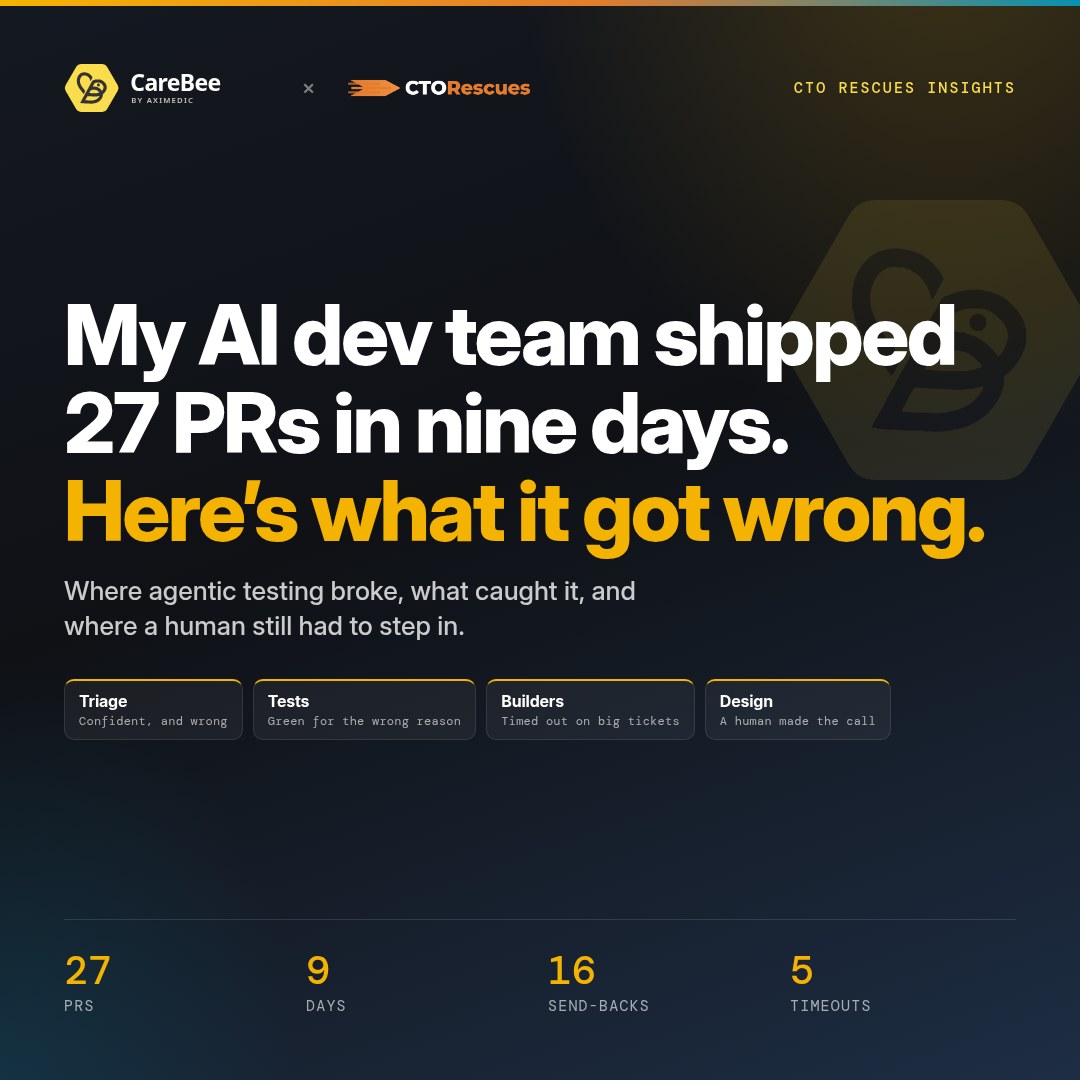
Two weeks ago I wrote about the eleven AI developers who built the working demo of CareBee in nine days: I hired eleven developers. None of them are human.
That piece was the highlight reel. This one is the game tape.
CareBee is a family caregiver app from AXIMEDIC, a Yom Shore Ventures company — carebeeapp.com. The demo was built by the CTO Rescues AI dev team.
I’m writing it now because the industry is at a turning point. Autonomous agents that plan, execute, triage and propose fixes are moving out of pilots and into real engineering and QA pipelines. Gartner now publishes a Magic Quadrant for agentic software quality assurance platforms. Google’s DORA research puts it bluntly: AI is an amplifier. It magnifies a team’s strengths and its dysfunctions.
That matches what we saw. Here’s what broke, what caught it, and where a human still had to step in.
The setup, in one paragraph
Higgins is my major-domo and AI chief of staff. He runs the dev team. Doug, the foreman, writes the spec. Mike, the tester, owns the acceptance tests, and the builders aren’t supposed to edit them. Bob and the other builders write the code. Steve, the lead reviewer, checks every change against Doug’s spec. Sandy reviews security. Sally reviews design and accessibility. Terry, the CI medic and librarian, watches the automated checks and records each project’s lessons. Every pull request ran automated checks and AI reviews before it reached me, and I pressed the merge button on all 27.
Failure 1: the reviewer was confident, and wrong
The very first pull request came back red. The automated check had failed.
Steve, our lead reviewer, read the diff and named a cause: two screens were still using navigation keys the change had removed. He rated his own confidence “high”. The builder made a fix pass. The check failed again. Steve repeated the same diagnosis, with the same confidence. The builder replied that it couldn’t reproduce the failure and asked for the check to be re-run.
Neither agent had found the real problem, which was nowhere in that pull request. The project had a lint step, but the lint tool itself had never been installed. The check would have failed on every ticket, no matter how good the code was. Higgins and I found it by running the check by hand, exactly the way the pipeline runs it, and reading the actual error. Steve’s finding turned out to be a plausible story that fit the symptom.
Lesson: an agent that triages a failure will give you a confident explanation every time. Confidence isn’t evidence. Make the agent show the failing command and its output before anyone touches code. Build that into your triage agent’s playbook as a hard rule: reproduce the failure first.
Failure 2: tests that pass without testing anything
This is the failure that should worry every CTO buying agentic testing.
- On one ticket, a builder changed an existing end-to-end step, which broke our rule that builders don’t edit Mike’s tests. It also wrapped a wait in a silent catch, so a timeout would never fail the test. Steve flagged it, and it was removed before merge.
- On another, a new date test was meant to check two cases. Because of a coding error, the second case could never run. After the fix, Steve found the assertion would still pass even if the countdown it was meant to check was missing. It took a second review to catch that.
- In a layout audit, Sandy, our security reviewer, noticed that if the element being checked disappeared, the check quietly passed.
None of these made the test suite go red. They made it go green for the wrong reasons. An agent asked to make the checks pass will sometimes do exactly that.
Lesson: test the tests. Protect your acceptance tests from the agents that write the code, and have a separate reviewer read every change to a test as carefully as a change to the product.
Failure 3: the builders ran out of road
The early tickets were small. The later ones (calendar, settings, billing, rewards) were bigger, and the builders started to time out. On five of the 27 pull requests, a build or fix run hit its time limit before it finished. One arrived with the feature code but without the end-to-end steps its spec required.
Those pull requests didn’t merge half-done. They were finished in a final, supervised cleanup pass before merge. Across the build, 18 of the 27 pull requests got a cleanup commit like that.
Size played a part too. We aimed for about 400 changed lines per pull request. Counting changed lines, 23 of the 27 went over that, and two went over the 800-line hard cap.
Lesson: autonomy has a size limit. Measure how often your agents finish without help, by ticket size, and split work before it reaches the size where they start failing.
Failure 4: three rounds of squeezing, one human decision
CareBee’s users need large text, so every screen is tested at 200% text size. One early ticket went back three times. At 200% text on a phone, the top bar couldn’t fit a back button, a title and a Skip button on one line. Each fix pass shrank or squeezed things a little more, and Sally and Steve kept sending it back.
The fix wasn’t more effort. It was a design decision: stop squeezing, and change the layout at large text. The title drops to its own row, and the profile header stacks vertically. I wrote that direction, and the next pass got it nearly right.
Lesson: agents are good at closing a defect. They are much weaker at seeing that the defect is a sign the design has to change. That call is still yours.
What the numbers say
- 27 pull requests merged between October 22 and October 30.
- 11 of them were sent back by me at least once, 16 send-backs in all.
- The first three tickets each took two or three rounds. By the fifth ticket we had capped every ticket at one fix pass, then a human decides.
- Doug’s later specs carried a “risks” section that quoted lessons from earlier tickets, so the next ticket started from what the last one learned. That’s what the librarian role is for.
Moving agentic testing from pilot to pipeline
If you’re a CTO, or you back companies that are about to bet on this, this is what I’d hold the line on:
- Make triage prove itself. No root-cause claim without the failing command and its real output.
- Wall off the tests. The agents that build the code shouldn’t be able to edit the tests that judge it. Treat any change to a test as high risk.
- Audit for green-for-the-wrong-reason. Look for silent catches, assertions that can’t fail, and checks that pass when the thing they check is missing.
- Track autonomy honestly. Count how much human rework and cleanup each merge needed. That number, not the demo, tells you if you’re ready to scale.
- Keep a human on design and merge. Agents can find defects and propose fixes. Deciding what “right” looks like is still a leadership job.
Agentic testing is real, and it caught a lot on this build. But the failures that got furthest were the quiet ones: a confident wrong diagnosis, a green test that checked nothing. Those are the ones that hurt in production.
Where have your AI agents fooled you, and what caught it?
If you want help moving agentic development and testing from pilot to pipeline without fooling yourself, I’m at dan@ctorescues.com.
#AgenticAI #SoftwareTesting #QualityAssurance #AI #SoftwareDevelopment #CTO #Leadership